La mano ("the hand") is one of the first Italian nouns you'll learn. It has a small surprise: although it ends in -o, like many masculine nouns, it is feminine (la mano, le mani).
But that's not the only interesting thing about this word. It has also given rise to a whole family of everyday Italian words—from maniglia (handle) and manuale (manual) to manette (handcuffs) and manodopera (workforce, labor). Once you see the common thread, they're much easier to remember.
Che tenerezza. -Sta in buone mani, dai.
How sweet. -She's in good hands, come on.
Caption 63, I Bastardi di Pizzofalcone S2 EP1 Cuccioli - Part 1
Play Caption
We can use it literally, as in shaking hands. Italian uses the singular: stringere la mano.
Avanti, sii sportivo, stringile la mano.
Come on, be sportsmanlike, shake her hand.
Captions 2-3, Provaci ancora prof! S3EP3 La terza vittima - Part 20
Play Caption
One important way to use mano is when you lend a hand. Italians use the verb dare (to give).
Intanto ti do una mano a finire le fettuccine.
In the meantime, I'll give you a hand finishing the fettuccine.
Caption 77, Com'è umano lui Film - Part 30
Play Caption
Several words for objects that we hold or operate with our hands contain the root man-. In many cases, Italian and
English have developed along similar lines. Even when the exact Italian word doesn’t immediately come to mind,
recognizing the root can help you understand it from the context.
The handle of a door (or many other objects) is una maniglia. Do we ever stop to think about the word hand inside the English word handle?
E sotto la maniglia abbiamo la toppa delle chiavi.
And beneath the door handle we have the keyhole.
Caption 12, Marika spiega L'ingresso di casa
Play Caption
Il manubrio has two common meanings. At the gym, it means a dumbbell: a weight designed to be held in one hand. It can also refer to the handlebar of a bicycle or motorcycle.
Be careful not to confuse un manubrio with un bilanciere, which is a barbell. In the following clip, the speaker says manubrio, but the object shown is actually a bilanciere.
Può pesare da uno a venti chili o di più. Si solleva con le braccia. Cos'è? Il manubrio [sic: bilanciere].
It can weigh from one to twenty kilos or more. One lifts it up with one's arms. What is it? A dumbbell [barbell].
Captions 38-41, Indovina un po' EP 16
Play Caption
È Lei che se prendeva una botta di manubrio sulla schiena, non avrebbe certo giovato alla sua lombalgia, eh.
You are the one who, if you had gotten hit by the handlebars in your back, for sure, it wouldn't have done your lumbago any good, huh.
Captions 13-14, Provaci ancora prof! S2EP2 Una mina vagante - Part 5
Play Caption
Let's hope you never have to use this next word:
Ti devo mettere le manette o stai tranquillo?
Do I have to put handcuffs on or will you stay quiet?
Caption 52, I Bastardi di Pizzofalcone S1EP2 Rabbia - Part 9
Play Caption
Finally, we have il manuale, which is a cognate of the English word "manual." It comes from a word meaning “of the hand” and now commonly refers to a handbook or guide — book you can hold in your hand.
Il problema è che non esiste un vero manuale su che cosa è corretto e cosa non è corretto.
The problem is that there is no real manual on what is proper and what is not proper.
Captions 28-29, Fumettology Diabolik - Part 8
Play Caption
I pomodori si staccano dalla pianta rigorosamente a mano, seguendo il grado di maturazione dei frutti.
The tomatoes are detached from the plant strictly by hand, according to the degree of the ripening of the fruit.
Captions 36-37, Pomodori Vulcanici Pomodori del Vesuvio - Part 1
Play Caption
When you go to Italy and want to buy a mug to take home, it might say: dipinto a mano (hand-painted).
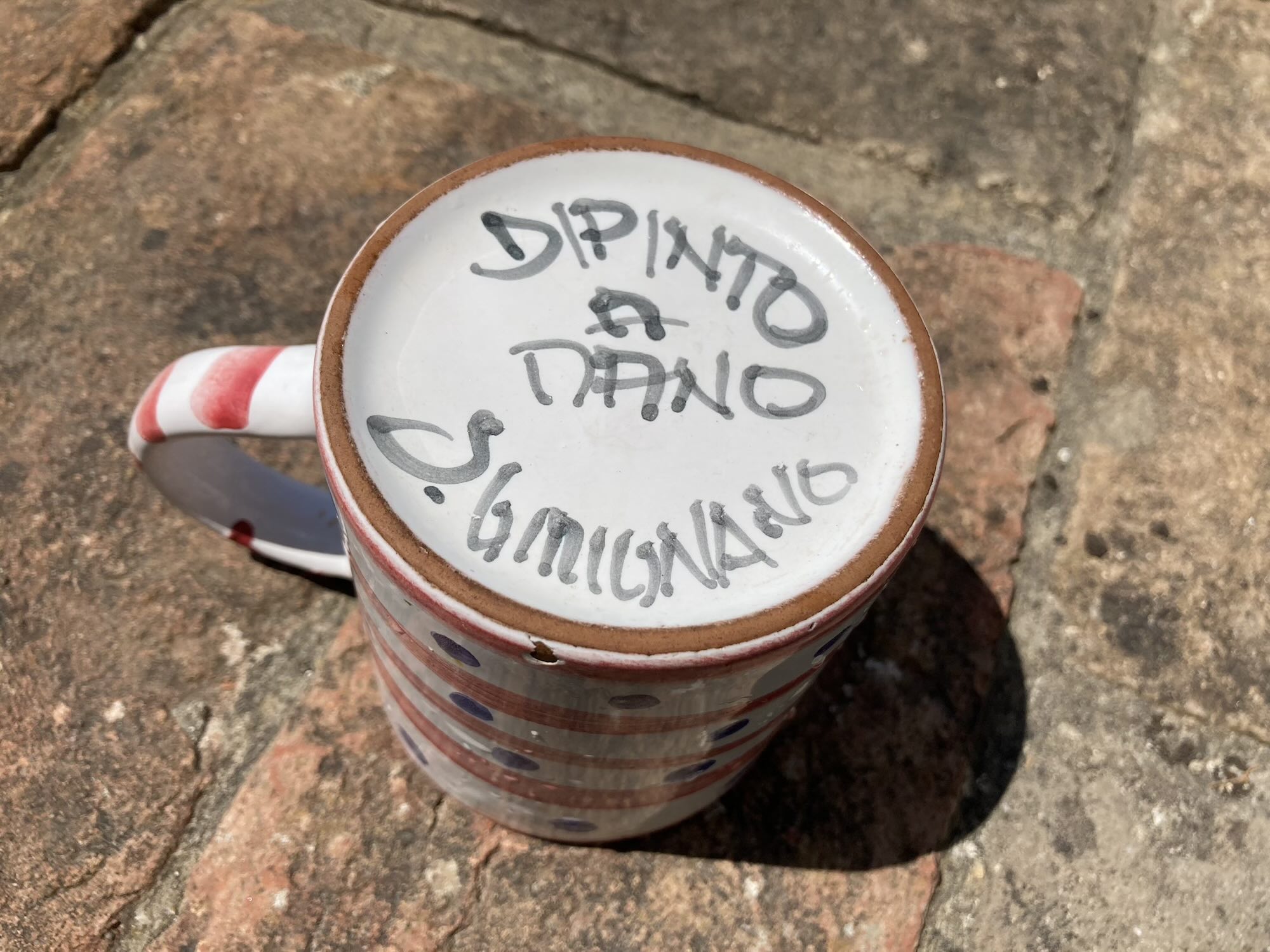
Some verbs also belong to the mano family. Maneggiare means “to handle,” “to operate,” or “to manipulate.”
Eh, questo è uno strumento tipico per maneggiare gli spaghetti o la pasta lunga.
Uh, this is a typical instrument for handling spaghetti or long pasta.
Captions 106-107, L'Italia a tavola Tonnarelli cacio e pepe - Part 1
Play Caption
At first, mantenere might not look as though it belongs to the same family. However, it comes from the Latin expression "manu tenere," meaning “to hold in the hand.” This helps explain why mantenere can mean “to maintain,” “to keep,” or “to support,” depending on the context.
Io non posso fidarmi di chi non può mantenere le promesse.
I can't trust someone who doesn't keep his promises.
Captions 15-16, Imma Tataranni Sostituto procuratore S1 EP4 Maltempo - Part 19
Play Caption
We also use mantenere to mean “to support,” as in parents financially supporting their children.
Ma come faccio a mantenere un figlio?
But how can I support a child?
Caption 25, Com'è umano lui Film - Part 10
Play Caption
If you do a search of mantenere (and the different conjugations, too), you'll find a wide variety of examples, with different contexts and nuances.
Per salire si paga un ticket, che serve per la bonifica e la manutenzione del sentiero.
To go up one buys a ticket, which is used for the reclaiming and maintenance of the trail.
Caption 28, Linea Blu Le Eolie - Part 16
Play Caption
When you have work done at home, it's typical to divide the bill into i materiali (the materials) and la manodopera (the labor). The word is made up of mano (hand) (that does the work) and d'opera (of the work, the job). It has become one word (univerbazione) but clearly was 3 separate words at one time. The word can also be written mano d’opera and refers either to the workers performing a job or to the cost of their labor.
Chi la paga la stoffa e la manodopera?
Who will pay for the fabric? And the labor?
Caption 41, Sposami EP 4 - Part 17
Play Caption
Italian is full of word families like this one. The more you notice the connections between related words, the easier it becomes to guess meanings and build your vocabulary naturally.
Thanks for reading. Write to us at [email protected].
Provare is a common word used in various contexts. We have talked about some in this lesson and in this one, too. It generally means "to try," but not only. In this lesson, we'll be talking about using the verb provare and related words in the context of music and other performing arts.
While a rock band or jazz band will likely practice, an orchestra, classical ensemble, or theater production rehearses. In Italian, the verb for both is generally provare. The group is trying things out if we think about it.
Da oggi, compreso oggi, abbiamo quattro giorni per provare prima che arrivi il maestro.
From today, including today, we have four days to rehearse before the maestro arrives.
Captions 39-40, La compagnia del cigno S1 EP3 - Part 2
Play Caption
But what do we call the rehearsal itself?
When it's at a specific time and place, we might hear it used in the singular. Let's keep in mind that "una prova" can have multiple meanings, and depending on the context, might not pertain to music or theater. Sometimes, especially for a band, the kind of prova will be specified, with the term la prova musicale (the musical rehearsal, the music practice session).
Be', io devo tornare, il ragazzetto rompicoglioni deve studiare, domani ho una prova importante. -E, no.
Well, I have to go back, the pain in the ass boy has to study. I have an important rehearsal tomorrow. -Hey, no.
Captions 43-44, La compagnia del cigno S2 EP 2 - Part 11
Play Caption
And there are certain cases in which the singular la prova is used for sure. The dress rehearsal is called "la prova generale."
Non sono preparato, non ho tempo, non ho dimestichezza con i bambini. -Ma è perfetto, con l'occasione fai una prova generale.
I'm not prepared, I don't have time, I'm not familiar with children. -But it's perfect, with this opportunity you'll do a dress rehearsal.
Captions 57-59, Provaci ancora prof! S3EP2 Doppio imprevisto - Part 15
Play Caption
But often, even when referring to one rehearsal, the plural is used. It's just what people say.
Anche oggi delle prove durissime.
Even today, a very tough rehearsal.
Caption 1, La compagnia del cigno EP 5 - Part 6
Play Caption
Non dovevate finire le prove alle sette?
Weren't you supposed to finish the rehearsal at seven?
Caption 60, La compagnia del cigno S1 EP3 - Part 9
Play Caption
Ti va di cenare insieme dopo le prove?
Do you want to have dinner together after the rehearsal?
Caption 14, La compagnia del cigno EP 5 - Part 9
Play Caption
In this next example, it's about a band. Fare le prove is literally, "to do/make the rehearsal/practice session."
Dove devi andare? A fare le prove per il concerto. -Mhh...
Where do you have to go? To practice for the concert. -Hmm...
Captions 29-30, Milena e Mattia L'incontro
Play Caption
But what about when you are at home or in your practice room practicing? That is studiare, which means, in a general context, "to study."
Be', io no, grazie. Sto qui a studiare così domani non perdete tempo.
Well, not me, thanks. I'll stay here to practice, that way, tomorrow you won't waste time.
Captions 68-70, La compagnia del cigno EP 6 - Part 2
Play Caption
Naturally, studiare also means studying for an exam.
Tu pensa a studiare che devi dare l'esame.
You think about studying because you have to take the exam.
Caption 49, Com'è umano lui Film - Part 9
Play Caption
But we need to be careful, because studiare can also mean someone is "going to school," in other words, attending a school of higher learning, such as a college or university, or even a high school, since not all kids go to high school.
Io non studio, non lavoro.
I don't study/I'm not going to school, I don't work.
Caption 24, Com'è umano lui Film - Part 10
Play Caption
In the series La compagnia del cigno, the kids both practice their instruments and study from books, so we need to determine the context to know what is meant sometimes.
Another way to translate "to practice" is esercitarsi. It can be a bit more specific to a certain passage or piece than studiare, which can be more general.
Va bene, grazie. -Quanto ti devi esercitare ancora?
All right, thanks. -How much more do you have to practice?
Caption 35, La compagnia del cigno S1 EP1 - Part 7
Play Caption
Thanks for reading. Hopefully, you have a better grasp of the words Italian musicians and actors (and others) use when they are practicing and rehearsing. There are other related words we will address in a future lesson. If you have comments or questions, we're all ears. Write to us at [email protected].
Let's zoom in on the noun la fiducia and related words. Fiducia means "trust," "faith," or "confidence," depending on the context. And there are related adjective and verb forms, which we will discuss, as well.
Devi andare alla polizia e costituirti spontaneamente. Abbi un po' di fiducia.
You have to go to the police and voluntarily turn yourself in. Have a little faith.
Captions 20-21, Provaci ancora prof! S2E5 Vita da cani - Part 20
Play Caption
There are a few different verbs we use with this noun:
Avere (to have):
Avere fiducia in qualcuno / qualcosa (to have trust in someone/something).
Ho sempre avuto fiducia in te,
I have always had faith in you,
Caption 32, Moscati, l'amore che guarisce EP 2 - Part 19
Play Caption
Dare (to give)
Dare fiducia a qualcuno (to give one's trust to someone, to trust someone).
Infatti, mi sto occupando da tempo, in prima persona, di questo problema, però Lei deve darmi un po' di fiducia.
In fact, I have been working for a while now, personally, on this problem, but you have to trust me a little.
Captions 13-14, Imma Tataranni Sostituto procuratore S1 EP4 Maltempo - Part 19
Play Caption
Perdere (to lose)
Perdere fiducia (to lose one's faith/trust).
Le parole bugiarde te [ti] fanno perde' [perdere] la fiducia.
Lying words make you lose trust.
Caption 43, Sposami EP 4 - Part 11
Play Caption
Related adjective: fiducioso / fiduciosa (trusting, optimistic)
Lascia stare, che il mistero a volte ti può tirare brutti scherzi. Ma io sono fiduciosa.
Forget that. Sometimes mystery plays nasty tricks. But I am confident/hopeful.
Captions 15-17, Sei mai stata sulla Luna? film - Part 13
Play Caption
Fiducioso can also mean "hopeful," because in this case, hope is based on trust.
So instead of saying, "I hope you will be on time," I might say, "I trust you will be on time."
Related verb: fidarsi (to trust)
In Italian, fidarsi is a reflexive verb.
This already makes it different from English.
1. Why fidarsi is reflexive:
Italian does not say “to trust” in the same direct way as English.
Instead of "I trust you," or "I trust in you," Italian often says:
Mi fido di te (literally: I entrust myself to you).
The reflexive pronoun (mi, ti, si, ci, vi) shows that trust is seen as an inner decision of the person who trusts, not just an action directed outward.
⸻
2. Fidarsi di + person / thing
The verb normally takes the preposition di (of).
Negli ultimi tempi, quali sono state le donne a contatto con Dodo? Qualcuna di cui lui potesse fidarsi?
In recent times, who were the women in contact with Dodo? Someone he could trust [in]?
Captions 43-45, I Bastardi di Pizzofalcone S1 EP6 Buio - Part 17
Play Caption
⸻
3. Why Italians can say just “Fidati.”
Italian often omits what is obvious from the context (the indirect object, for example).
• Fidati. = Trust me / Trust it / Trust.
Even if di me is not said, it is understood.
The following example has two instances of fidarsi. The first is in the imperative and we hear it all the time. The second is the first person singular, which is handy to recognize and remember.
Non ci facciamo una figuraccia con questo Marsili, no? Fidati. -Mi fido di più se mi dici chi te l'ha detto. -Una persona molto affidabile.
We're not going to look like idiots with this Marsili, right? Trust me. -I trust [you] more if you tell me who told you. -A very reliable person.
Captions 50-53, Il Commissario Manara S1EP5 - Il Raggio Verde - Part 6
Play Caption
Let's also note that the root fida is part of the adjective affidabile (reliable, trustworthy). The opposite is inaffidabile.
Che tu ci sei [sic: sia] rimasta male lo capisco, però che Paolo sia inaffidabile lo sapevamo.
I understand that you are upset, but we knew that Paolo was unreliable.
Captions 34-35, Com'è umano lui Film - Part 10
Play Caption
And here's a first-person singular conjugation of fidarsi in the negative:
Tanto ho capito, io il tipo l'ho inquadrato. Non mi fido.
Anyway I understand, I have that type figured out. I don't trust [him].
Captions 44-45, Il Commissario Manara S1EP1 - Un delitto perfetto - Part 8
Play Caption
Note that in the negative imperative, the infinitive form of the verb is used (in the familiar second-person).
Libero, non ti fidare.
Libero, don't trust [him].
Caption 30, Un medico in famiglia Stagione 1 EP 4 Buon Compleanno Maria - Part 4
Play Caption
Leaving out the object sounds quite natural in Italian, but can be confusing for learners who expect it.
In English, saying only “Trust.” sounds incomplete.
In Italian, Fidati. works as a complete sentence.
Thanks for reading. We hope you have a better understanding now of fiducia and related words. Write to us at [email protected].
You might have heard Italians saying, "D'accordo" to mean "OK," or "all right," in your travels, in movies and TV shows, or elsewhere. Depending on the context and inflection, it can be posed as a question:
D'accordo?
All right?
Caption 29, Provaci ancora prof! S2E5 Vita da cani - Part 8
Play Caption
Or it can be a statement of agreement.
D'accordo.
All right.
Caption 73, I Bastardi di Pizzofalcone S1EP2 Rabbia - Part 20
Play Caption
There are various ways to use d'accordo and its main noun, accordo (agreement). We've mentioned some of them in this lesson.
But there is also a verb form, accordare. One common use of this verb is in music. It means "to tune," such as the strings of a musical instrument.
Ah, perfetto. -Accordare la chitarra. -Sì.
Ah, perfect. -To tune a guitar. -Yes.
Caption 67, L'Eredità -Quiz TV La sfida dei sei. Puntata 2 - Part 10
Play Caption
You might have heard Daniela use accordare when talking about "agreement" between various parts of speech.
Chiaramente, se il soggetto è plurale il verbo va accordato anche alla terza persona plurale.
Clearly, if the subject is plural the verb has to agree in the third person plural, as well.
Captions 3-4, Corso di italiano con Daniela La forma passiva - Part 3
Play Caption
It's very common to use mettersi d'accordo to come to an agreement or essere d'accordo to agree or to be in agreement:
Dai, ti sei messa d'accordo con Polio e Faber per farmi uno scherzo
Come on, you ganged up with Polio and Faber to play a joke on me,
Caption 15, Com'è umano lui Film - Part 10
Play Caption
Sono d'accordo con te.
I agree with you.
Caption 9, I Bastardi di Pizzofalcone S1EP5 Misericordia - Part 25
Play Caption
But it's also possible to use the reflexive verb accordarsi.
Gli sposi devono accordarsi su un piccolo particolare della formula, nessun problema.
The bride and groom have to come to an agreement about a little detail for their vows, no problem.
Caption 19, Sposami EP 5 - Part 21
Play Caption
Finally, accordare can also mean "to grant." In this case, it's transitive.
Ma, veramente, commissario, ha preso un giorno di permesso. Ma gliel'ha accordato Lei, prima di partire.
But actually, Commissioner, she took a personal day. But you granted it to her, before leaving.
Captions 5-6, Il Commissario Manara S1EP6 - Reazione a Catena - Part 2
Play Caption
Permesso accordato.
Permission granted.
Caption 106, Provaci ancora prof! S3 EP2 Doppio imprevisto - Part 20
Play Caption
Thanks for reading. Send your questions and comments to [email protected] or use the comments section of the video you happen to be watching.

 Spanish
 French
 German
 Chinese
 English
 English
  Español
 Français
 Deutsch
 Italiano