La mano ("the hand") is one of the first Italian nouns you'll learn. It has a small surprise: although it ends in -o, like many masculine nouns, it is feminine (la mano, le mani).
But that's not the only interesting thing about this word. It has also given rise to a whole family of everyday Italian words—from maniglia (handle) and manuale (manual) to manette (handcuffs) and manodopera (workforce, labor). Once you see the common thread, they're much easier to remember.
Che tenerezza. -Sta in buone mani, dai.
How sweet. -She's in good hands, come on.
Caption 63, I Bastardi di Pizzofalcone S2 EP1 Cuccioli - Part 1
Play Caption
We can use it literally, as in shaking hands. Italian uses the singular: stringere la mano.
Avanti, sii sportivo, stringile la mano.
Come on, be sportsmanlike, shake her hand.
Captions 2-3, Provaci ancora prof! S3EP3 La terza vittima - Part 20
Play Caption
One important way to use mano is when you lend a hand. Italians use the verb dare (to give).
Intanto ti do una mano a finire le fettuccine.
In the meantime, I'll give you a hand finishing the fettuccine.
Caption 77, Com'è umano lui Film - Part 30
Play Caption
Several words for objects that we hold or operate with our hands contain the root man-. In many cases, Italian and
English have developed along similar lines. Even when the exact Italian word doesn’t immediately come to mind,
recognizing the root can help you understand it from the context.
The handle of a door (or many other objects) is una maniglia. Do we ever stop to think about the word hand inside the English word handle?
E sotto la maniglia abbiamo la toppa delle chiavi.
And beneath the door handle we have the keyhole.
Caption 12, Marika spiega L'ingresso di casa
Play Caption
Il manubrio has two common meanings. At the gym, it means a dumbbell: a weight designed to be held in one hand. It can also refer to the handlebar of a bicycle or motorcycle.
Be careful not to confuse un manubrio with un bilanciere, which is a barbell. In the following clip, the speaker says manubrio, but the object shown is actually a bilanciere.
Può pesare da uno a venti chili o di più. Si solleva con le braccia. Cos'è? Il manubrio [sic: bilanciere].
It can weigh from one to twenty kilos or more. One lifts it up with one's arms. What is it? A dumbbell [barbell].
Captions 38-41, Indovina un po' EP 16
Play Caption
È Lei che se prendeva una botta di manubrio sulla schiena, non avrebbe certo giovato alla sua lombalgia, eh.
You are the one who, if you had gotten hit by the handlebars in your back, for sure, it wouldn't have done your lumbago any good, huh.
Captions 13-14, Provaci ancora prof! S2EP2 Una mina vagante - Part 5
Play Caption
Let's hope you never have to use this next word:
Ti devo mettere le manette o stai tranquillo?
Do I have to put handcuffs on or will you stay quiet?
Caption 52, I Bastardi di Pizzofalcone S1EP2 Rabbia - Part 9
Play Caption
Finally, we have il manuale, which is a cognate of the English word "manual." It comes from a word meaning “of the hand” and now commonly refers to a handbook or guide — book you can hold in your hand.
Il problema è che non esiste un vero manuale su che cosa è corretto e cosa non è corretto.
The problem is that there is no real manual on what is proper and what is not proper.
Captions 28-29, Fumettology Diabolik - Part 8
Play Caption
I pomodori si staccano dalla pianta rigorosamente a mano, seguendo il grado di maturazione dei frutti.
The tomatoes are detached from the plant strictly by hand, according to the degree of the ripening of the fruit.
Captions 36-37, Pomodori Vulcanici Pomodori del Vesuvio - Part 1
Play Caption
When you go to Italy and want to buy a mug to take home, it might say: dipinto a mano (hand-painted).
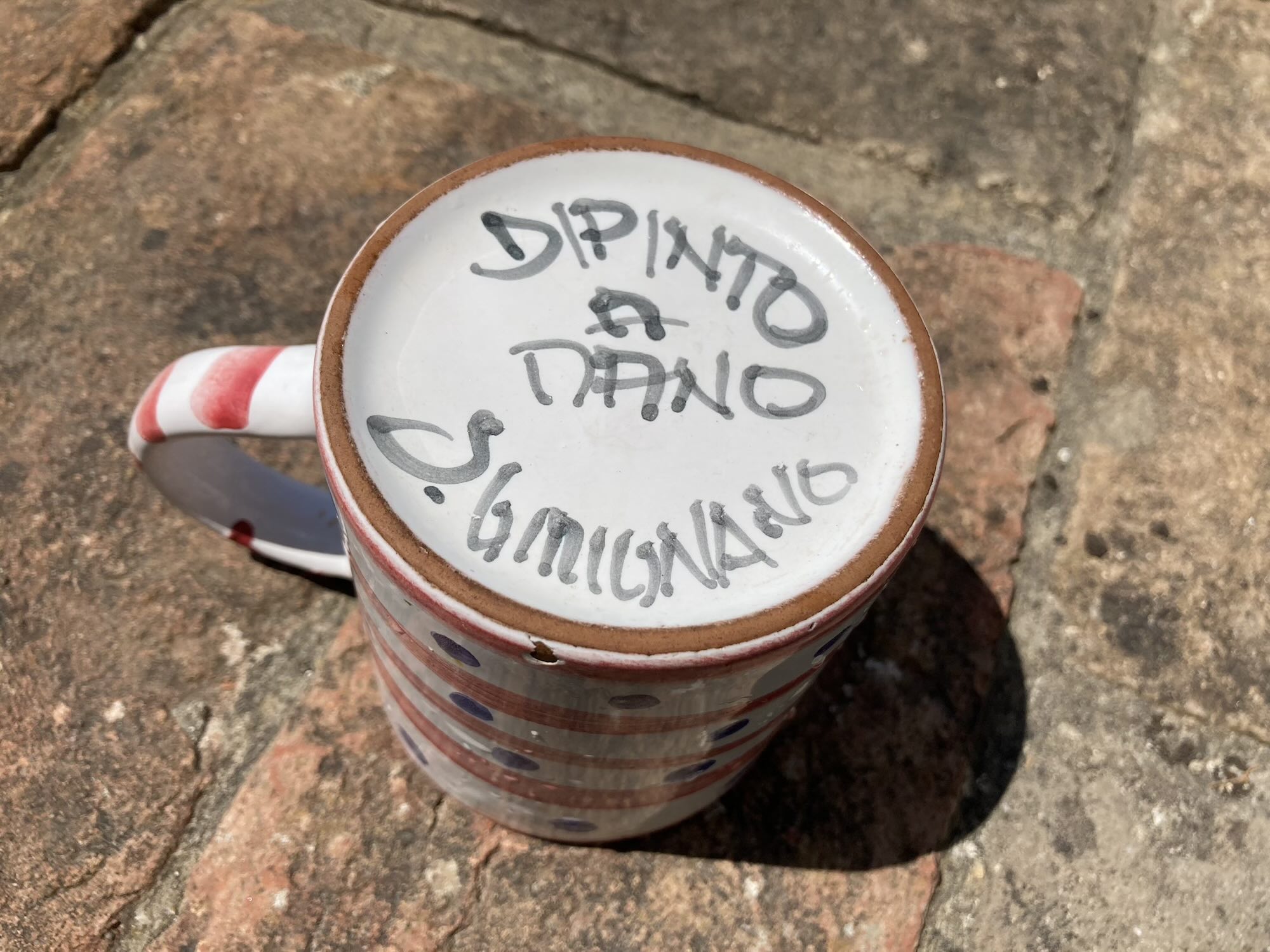
Some verbs also belong to the mano family. Maneggiare means “to handle,” “to operate,” or “to manipulate.”
Eh, questo è uno strumento tipico per maneggiare gli spaghetti o la pasta lunga.
Uh, this is a typical instrument for handling spaghetti or long pasta.
Captions 106-107, L'Italia a tavola Tonnarelli cacio e pepe - Part 1
Play Caption
At first, mantenere might not look as though it belongs to the same family. However, it comes from the Latin expression "manu tenere," meaning “to hold in the hand.” This helps explain why mantenere can mean “to maintain,” “to keep,” or “to support,” depending on the context.
Io non posso fidarmi di chi non può mantenere le promesse.
I can't trust someone who doesn't keep his promises.
Captions 15-16, Imma Tataranni Sostituto procuratore S1 EP4 Maltempo - Part 19
Play Caption
We also use mantenere to mean “to support,” as in parents financially supporting their children.
Ma come faccio a mantenere un figlio?
But how can I support a child?
Caption 25, Com'è umano lui Film - Part 10
Play Caption
If you do a search of mantenere (and the different conjugations, too), you'll find a wide variety of examples, with different contexts and nuances.
Per salire si paga un ticket, che serve per la bonifica e la manutenzione del sentiero.
To go up one buys a ticket, which is used for the reclaiming and maintenance of the trail.
Caption 28, Linea Blu Le Eolie - Part 16
Play Caption
When you have work done at home, it's typical to divide the bill into i materiali (the materials) and la manodopera (the labor). The word is made up of mano (hand) (that does the work) and d'opera (of the work, the job). It has become one word (univerbazione) but clearly was 3 separate words at one time. The word can also be written mano d’opera and refers either to the workers performing a job or to the cost of their labor.
Chi la paga la stoffa e la manodopera?
Who will pay for the fabric? And the labor?
Caption 41, Sposami EP 4 - Part 17
Play Caption
Italian is full of word families like this one. The more you notice the connections between related words, the easier it becomes to guess meanings and build your vocabulary naturally.
Thanks for reading. Write to us at [email protected].
Let's talk about two important Italian adverbs of time: già and ormai
Già, meaning "already" comes from the Latin "iam," later spelled "jam," meaning "already," "now," or "presently" in English. It indicates a change of state, that something has occurred "by this time." It then became già in Italian. We could say già marks a transition between a previous and present moment in time. In other words, we're talking about something that has happened in the past relative to the present or relative to a more recent point in the past, in the case of past tenses.
Perché casa mia non era all'altezza? -Te l'ho già detto, per adesso sono felice di aver lasciato casa dei miei.
Because my house wasn't up to par? -I already told you. For now, I'm happy to have left my parents' house.
Captions 4-6, I Bastardi di Pizzofalcone S2 EP1 Cuccioli - Part 14
Play Caption
The example above is something people say quite often: Te l'ho già detto (I already told you that).
If we think about the English translation of già, "already" does the trick most of the time.
Anzi, il destro [è] di diverso colore, quindi era già stato sostituito.
Rather, the right one [is] of a different color, so it had already been replaced.
Captions 33-35, Autocollection EP2 - Part 8
Play Caption
Be', forse era già incinta.
Well, maybe she was already pregnant.
Caption 71, I Bastardi di Pizzofalcone S2 EP1 Cuccioli - Part 12
Play Caption
On a practical level, however, there are nuances that an Italian-Italian dictionary such as Treccani will point out. And if we look at the etymology (etimologia) of a word, it can help provide insights into its meanings and deepen our understanding, depending on where we are coming from. If someone has studied Latin, for example, etymology can be quite helpful. Or if someone knows French or Spanish, there can be clues to help us remember an Italian word, for instance, in Spanish, "ya," and in French "déjà," in the case of già.
A common expression is Già fatto (already done/[I've] done it already)! In this case, we don't need to add a personal pronoun and the auxiliary verb avere (to have). È una frase fatta (it's an idiomatic expression) meaning "already done/taken care of."
Bisogna chiamare subito il commissario. -Già fatto, ma ha il cellulare spento.
We have to call the chief right away. -Already done, but his phone is off.
Captions 31-32, Provaci ancora prof! S2EP1 - La finestra sulla scuola - Part 17
Play Caption
Già fatto can also be posed as a question: Già fatto (are you already done)? And when we want to ask, "Already?", we can use: di già?
Io vado, eh. -Di già?
I'm going, huh. -Already?
Caption 43, JAMS EP6 - Part 4
Play Caption
We can also use già all by itself, or preceded by eh, to confirm something someone has said, as in, "Oh, right," "Yeah," "Yes, of course," or "Yeah, yeah."
Gli uomini sposati non le lasciano le mogli. -Già.
Married men never leave their wives. -Yeah/Oh, right.
Captions 83-84, Il Commissario Manara S2EP8 - Fuori servizio - Part 4
Play Caption
It's often used after person A reminds person B of something, and person B remembers and says Già or Eh, già.
Vieni a prenderlo. -Hai promesso. -Eh, già, i patti sono patti.
Come and get it. -You promised. -Yeah, yeah, a deal's a deal.
Captions 55-56, Il Commissario Manara S2EP4 - Miss Maremma - Part 7
Play Caption
Ormai or oramai (both are correct) can mean "by now," "at this point," or "already." The difference between già and ormai is in relation to the current moment. As opposed to ora (now) and già (already), which primarily refer to the present and the past, respectively, we use ormai to emphasize the passage of time and its relevance to the current situation, so it's more about the relationship between the past and the present.
In the following example, ormai has been translated as "now," but only because it's together with "for some time."
È il progetto del grande centro residenziale a cui stiamo lavorando ormai da tempo.
It is the project of the large residential complex on which we have been working for some time now.
Captions 13-14, Imma Tataranni Sostituto procuratore S1 EP5 Rione Serra Venerdì - Part 6
Play Caption
The most common English equivalents for ormai are "at this point" and "by now." If you are thinking in English and looking for the right Italian word, ormai is your friend.
Ormai è sicuro, gatta ci cala [sic: ci cova].
At this point, it is certain that something fishy is going on.
Caption 39, Provaci ancora prof! S2E6 La strana ossessione - Part 6
Play Caption
Una precisione: Note that, even though a sentence can be in the past, oramai or ormai doesn't change, but the English translation will change from "by now" to "by then," or from "at this point" to "at that point."
Era l'unico modo che avevo per bloccarla e mi sono pentito subito dopo, ma ormai era troppo tardi.
It was the only way I had to block her and I regretted it right after that, but at that point it was too late.
Captions 62-64, Imma Tataranni Sostituto procuratore S1 EP4 Maltempo - Part 19
Play Caption
When it's too late to change a situation, ormai is a good word. In other words the person is saying, "Well, if you didn't want to disturb me, it's too late because you have already disturbed me."
No, no, non mi disturbi, cioè, sì, anche se mi disturbi, ormai è fatta.
No, no, you are not interrupting me, I mean, yes, even if you're interrupting me, at this point, it's done.
Captions 28-29, Provaci ancora prof! S2E4 L'amica americana - Part 19
Play Caption
Niente, che non rispondono nemmeno ai messaggi, quindi mi sa che ormai non vengono.
Nothing, they're not even replying to texts, so I guess they're not coming at this point/by now.
Captions 11-12, La compagnia del cigno EP 5 - Part 13
Play Caption
As we mentioned above, oramai and ormai are equivalents, but in everyday, informal speech, ormai is more common. Nonetheless, we do see oramai used occasionally. Here, we have oramai plus già! Ungaretti was a writer and a poet, and was born in 1888, so it's not surprising he said the more archaic oramai.
C'era il mondo elegante di Roma e c'erano centinaia e centinaia di studenti che stavano nei corridoi perché non riuscivano a entrare nella, nell'aula magna oramai già gremita di gente.
There was the elegant world of Rome, and there were hundreds and hundreds of students who were in the corridors because they couldn't enter, in the great hall, by then, already crowded with people.
Captions 41-44, Giuseppe Ungaretti Intervista - Part 1
Play Caption
Daniela teaches a lesson devoted to ormai. Check out the video here.
Thanks for reading. Doing a search of già and ormai on the videos page will bring up dozens more authentic examples of these adverbs. If you see some examples that you have trouble understanding, please leave a comment or write to us at [email protected].
Let's zoom in on the noun la fiducia and related words. Fiducia means "trust," "faith," or "confidence," depending on the context. And there are related adjective and verb forms, which we will discuss, as well.
Devi andare alla polizia e costituirti spontaneamente. Abbi un po' di fiducia.
You have to go to the police and voluntarily turn yourself in. Have a little faith.
Captions 20-21, Provaci ancora prof! S2E5 Vita da cani - Part 20
Play Caption
There are a few different verbs we use with this noun:
Avere (to have):
Avere fiducia in qualcuno / qualcosa (to have trust in someone/something).
Ho sempre avuto fiducia in te,
I have always had faith in you,
Caption 32, Moscati, l'amore che guarisce EP 2 - Part 19
Play Caption
Dare (to give)
Dare fiducia a qualcuno (to give one's trust to someone, to trust someone).
Infatti, mi sto occupando da tempo, in prima persona, di questo problema, però Lei deve darmi un po' di fiducia.
In fact, I have been working for a while now, personally, on this problem, but you have to trust me a little.
Captions 13-14, Imma Tataranni Sostituto procuratore S1 EP4 Maltempo - Part 19
Play Caption
Perdere (to lose)
Perdere fiducia (to lose one's faith/trust).
Le parole bugiarde te [ti] fanno perde' [perdere] la fiducia.
Lying words make you lose trust.
Caption 43, Sposami EP 4 - Part 11
Play Caption
Related adjective: fiducioso / fiduciosa (trusting, optimistic)
Lascia stare, che il mistero a volte ti può tirare brutti scherzi. Ma io sono fiduciosa.
Forget that. Sometimes mystery plays nasty tricks. But I am confident/hopeful.
Captions 15-17, Sei mai stata sulla Luna? film - Part 13
Play Caption
Fiducioso can also mean "hopeful," because in this case, hope is based on trust.
So instead of saying, "I hope you will be on time," I might say, "I trust you will be on time."
Related verb: fidarsi (to trust)
In Italian, fidarsi is a reflexive verb.
This already makes it different from English.
1. Why fidarsi is reflexive:
Italian does not say “to trust” in the same direct way as English.
Instead of "I trust you," or "I trust in you," Italian often says:
Mi fido di te (literally: I entrust myself to you).
The reflexive pronoun (mi, ti, si, ci, vi) shows that trust is seen as an inner decision of the person who trusts, not just an action directed outward.
⸻
2. Fidarsi di + person / thing
The verb normally takes the preposition di (of).
Negli ultimi tempi, quali sono state le donne a contatto con Dodo? Qualcuna di cui lui potesse fidarsi?
In recent times, who were the women in contact with Dodo? Someone he could trust [in]?
Captions 43-45, I Bastardi di Pizzofalcone S1 EP6 Buio - Part 17
Play Caption
⸻
3. Why Italians can say just “Fidati.”
Italian often omits what is obvious from the context (the indirect object, for example).
• Fidati. = Trust me / Trust it / Trust.
Even if di me is not said, it is understood.
The following example has two instances of fidarsi. The first is in the imperative and we hear it all the time. The second is the first person singular, which is handy to recognize and remember.
Non ci facciamo una figuraccia con questo Marsili, no? Fidati. -Mi fido di più se mi dici chi te l'ha detto. -Una persona molto affidabile.
We're not going to look like idiots with this Marsili, right? Trust me. -I trust [you] more if you tell me who told you. -A very reliable person.
Captions 50-53, Il Commissario Manara S1EP5 - Il Raggio Verde - Part 6
Play Caption
Let's also note that the root fida is part of the adjective affidabile (reliable, trustworthy). The opposite is inaffidabile.
Che tu ci sei [sic: sia] rimasta male lo capisco, però che Paolo sia inaffidabile lo sapevamo.
I understand that you are upset, but we knew that Paolo was unreliable.
Captions 34-35, Com'è umano lui Film - Part 10
Play Caption
And here's a first-person singular conjugation of fidarsi in the negative:
Tanto ho capito, io il tipo l'ho inquadrato. Non mi fido.
Anyway I understand, I have that type figured out. I don't trust [him].
Captions 44-45, Il Commissario Manara S1EP1 - Un delitto perfetto - Part 8
Play Caption
Note that in the negative imperative, the infinitive form of the verb is used (in the familiar second-person).
Libero, non ti fidare.
Libero, don't trust [him].
Caption 30, Un medico in famiglia Stagione 1 EP 4 Buon Compleanno Maria - Part 4
Play Caption
Leaving out the object sounds quite natural in Italian, but can be confusing for learners who expect it.
In English, saying only “Trust.” sounds incomplete.
In Italian, Fidati. works as a complete sentence.
Thanks for reading. We hope you have a better understanding now of fiducia and related words. Write to us at [email protected].
Trusting someone or not is important to be able to express in the language you are using. But it can be tricky in Italian because "to trust" happens to be a reflexive verb.
A reflexive verb in Italian is a particular kind of verb where the subject and object are the same and which requires a reflexive pronoun. In the infinitive, we use the reflexive pronoun si (attached to the end of the verb). For more on reflexive verbs, see this lesson.
Before discussing how fidarsi works, let's look at a passage from a recent video on Yabla — Provaci ancora prof!. Renzo realizes he has been unfairly questioning his wife Camilla's relationship with reality.
Sì, va be', forse dovrei imparare a fidarmi un po' di più.
Yes, OK, maybe I should learn to trust you a bit more.
Caption 110, Provaci ancora prof! S2E6 La strana ossessione - Part 16
Play Caption
One of our subscribers wondered if fidarmi was a mistake, if it should have been fidarti, since, after all, Renzo is talking about trusting the person he is talking to. That's what makes verbs like fidarsi tricky for English speakers. Renzo left out the part where it would have been clearer. He could have said:
Sì, va be', forse dovrei imparare a fidarmi di te un po' di più.
He didn't say it, because it was clear who he was referring to and it was part of a longer conversation. It also makes for an awkward sentence.
Here is the sentence in context where Camilla speaks first.
Però almeno capisci che non sono pazza.
-Sì, va be', forse dovrei imparare a fidarmi un po' di più. -Eh, forse. -La fiducia è importante.
But at least you understand that I am not crazy.
-Yes, OK, maybe I should learn to trust you a bit more. -Yeah, maybe. -Trust is important.
Captions 109-111, Provaci ancora prof! S2E6 La strana ossessione - Part 16
Play Caption
Here’s how fidarsi works:
In a simple sentence, the reflexive pronoun is placed before the verb. The tricky thing to remember is that the reflexive pronoun corresponds to the subject, in other words, the person who is doing the trusting (or not). To trust is a transitive verb in English.
Here’s the conjugation in the present tense:
Io mi fido (I trust)
Tu ti fidi (you trust)
Lui/Lei si fida (he/she trusts)
Noi ci fidiamo (we trust)
Voi vi fidate (you all trust)
Loro si fidano (they trust)
Notice the reflexive pronouns (mi, ti, si, ci, vi, si) placed before the verb. In fact, we don't normally need to include the subject at all because it's clear from the verb conjugation (note the changing endings of the verb):
Mi fido (I trust)
Ti fidi (you trust)
Si fida (he/she trusts)
Ci fidiamo (we trust)
Vi fidate (you all trust)
Si fidano (they trust)
To make these sentences negative, where you don't trust someone or something, we place non (not) before the reflexive pronoun.
Non mi fido (I don't trust)
Non ti fidi (you don't trust)
Non si fida (he/she doesn't trust)
Non ci fidiamo (we don't trust)
Non vi fidate (you all don't trust)
Non si fidano (they don't trust)
In Italian, it's common to use this short phrase as is, with no other object. The object is implied. In English, however, we use "to trust" as a transitive verb with an object.
Tanto ho capito, io il tipo l'ho inquadrato. Non mi fido.
Anyway I understand, I have that type figured out. I don't trust him.
Caption 38, Il Commissario Manara S1EP1 - Un delitto perfetto - Part 8
Play Caption
But when specifying whom or what you trust (thus including an indirect pronoun), we follow fidarsi with the preposition di (in, of).
Non devi avere paura, ci penso io a te, non ti devi preoccupare. -Io mi fido di Lei.
You shouldn't be afraid, I'll take care of you, you shouldn't worry. -I trust you.
Captions 14-16, La linea verticale EP4 - Part 6
Play Caption
Io non mi fido di te.
I don't trust you.
Caption 35, Sposami EP 1 - Part 1
Play Caption
It might be helpful to remember that in English we sometimes do use a preposition, saying, "I trust in you" or "I trust in God."
Here's an example of a question using a compound past tense:
Ti rendi conto di chi mi sono fidata?
Do you realize whom I trusted?
Caption 10, Provaci ancora prof! S1E2 - Un amore pericoloso - Part 24
Play Caption
We have the noun la fiducia, too.
Ho pienamente riconquistato la tua fiducia?
Have I fully reconquered your trust?
Caption 83, Provaci ancora prof! S2E6 La strana ossessione - Part 15
Play Caption
La fiducia does mean "the trust," but it also means "the faith" (which can also translate as la fede in Italian, especially in the context of religion). Note also that after fiducia, the preposition is in (in). It works much like the English "to have faith in someone."
Ho sempre avuto fiducia in te,
I have always had faith in you,
Caption 32, Moscati, l'amore che guarisce EP 2 - Part 19
Play Caption
We use la fiducia with the verb avere (to have), just like in English, but we can also use the verb dare (to give), in which case it makes more sense to translate this with "to trust."
Infatti, mi sto occupando da tempo, in prima persona, di questo problema, però Lei deve darmi un po' di fiducia.
In fact, I have been working for a while now, personally, on this problem, but you have to trust me a little.
Captions 13-14, Imma Tataranni Sostituto procuratore S1 EP 4 Maltempo - Part 19
Play Caption
So when I want to simply say, "Trust me" I just say: Fidati. No need to say fidati di me unless I need or want to emphasize or be clear about who should be trusted.
Non ci facciamo una figuraccia con questo Marsili, no? -Fidati. -Mi fido di più se mi dici chi te l'ha detto. -Una persona molto affidabile.
We're not going to look like idiots with this Marsili, right? -Trust me. -I trust you more if you tell me who told you. -A very reliable person.
Captions 50-53, Il Commissario Manara S1EP5 - Il Raggio Verde - Part 6
Play Caption
We hope we have given you a better understanding of the reflexive verb fidarsi and the noun la fiducia, both of which have to do with trust. With a little practice, you'll be able to use both of these words with confidence in your Italian conversations.

 Spanish
 French
 German
 Chinese
 English
 English
  Español
 Français
 Deutsch
 Italiano