La mano ("the hand") is one of the first Italian nouns you'll learn. It has a small surprise: although it ends in -o, like many masculine nouns, it is feminine (la mano, le mani).
But that's not the only interesting thing about this word. It has also given rise to a whole family of everyday Italian words—from maniglia (handle) and manuale (manual) to manette (handcuffs) and manodopera (workforce, labor). Once you see the common thread, they're much easier to remember.
Che tenerezza. -Sta in buone mani, dai.
How sweet. -She's in good hands, come on.
Caption 63, I Bastardi di Pizzofalcone S2 EP1 Cuccioli - Part 1
Play Caption
We can use it literally, as in shaking hands. Italian uses the singular: stringere la mano.
Avanti, sii sportivo, stringile la mano.
Come on, be sportsmanlike, shake her hand.
Captions 2-3, Provaci ancora prof! S3EP3 La terza vittima - Part 20
Play Caption
One important way to use mano is when you lend a hand. Italians use the verb dare (to give).
Intanto ti do una mano a finire le fettuccine.
In the meantime, I'll give you a hand finishing the fettuccine.
Caption 77, Com'è umano lui Film - Part 30
Play Caption
Several words for objects that we hold or operate with our hands contain the root man-. In many cases, Italian and
English have developed along similar lines. Even when the exact Italian word doesn’t immediately come to mind,
recognizing the root can help you understand it from the context.
The handle of a door (or many other objects) is una maniglia. Do we ever stop to think about the word hand inside the English word handle?
E sotto la maniglia abbiamo la toppa delle chiavi.
And beneath the door handle we have the keyhole.
Caption 12, Marika spiega L'ingresso di casa
Play Caption
Il manubrio has two common meanings. At the gym, it means a dumbbell: a weight designed to be held in one hand. It can also refer to the handlebar of a bicycle or motorcycle.
Be careful not to confuse un manubrio with un bilanciere, which is a barbell. In the following clip, the speaker says manubrio, but the object shown is actually a bilanciere.
Può pesare da uno a venti chili o di più. Si solleva con le braccia. Cos'è? Il manubrio [sic: bilanciere].
It can weigh from one to twenty kilos or more. One lifts it up with one's arms. What is it? A dumbbell [barbell].
Captions 38-41, Indovina un po' EP 16
Play Caption
È Lei che se prendeva una botta di manubrio sulla schiena, non avrebbe certo giovato alla sua lombalgia, eh.
You are the one who, if you had gotten hit by the handlebars in your back, for sure, it wouldn't have done your lumbago any good, huh.
Captions 13-14, Provaci ancora prof! S2EP2 Una mina vagante - Part 5
Play Caption
Let's hope you never have to use this next word:
Ti devo mettere le manette o stai tranquillo?
Do I have to put handcuffs on or will you stay quiet?
Caption 52, I Bastardi di Pizzofalcone S1EP2 Rabbia - Part 9
Play Caption
Finally, we have il manuale, which is a cognate of the English word "manual." It comes from a word meaning “of the hand” and now commonly refers to a handbook or guide — book you can hold in your hand.
Il problema è che non esiste un vero manuale su che cosa è corretto e cosa non è corretto.
The problem is that there is no real manual on what is proper and what is not proper.
Captions 28-29, Fumettology Diabolik - Part 8
Play Caption
I pomodori si staccano dalla pianta rigorosamente a mano, seguendo il grado di maturazione dei frutti.
The tomatoes are detached from the plant strictly by hand, according to the degree of the ripening of the fruit.
Captions 36-37, Pomodori Vulcanici Pomodori del Vesuvio - Part 1
Play Caption
When you go to Italy and want to buy a mug to take home, it might say: dipinto a mano (hand-painted).
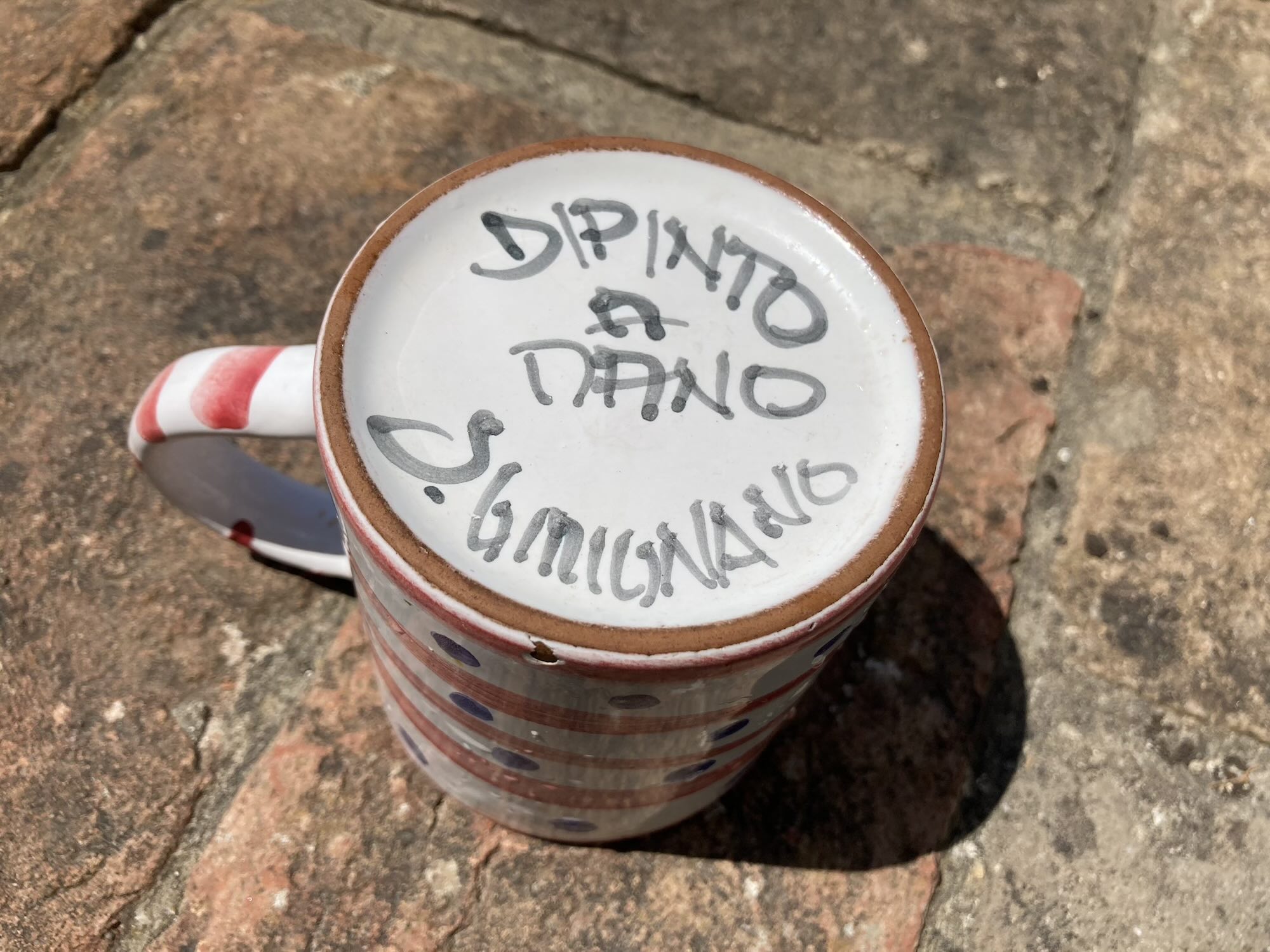
Some verbs also belong to the mano family. Maneggiare means “to handle,” “to operate,” or “to manipulate.”
Eh, questo è uno strumento tipico per maneggiare gli spaghetti o la pasta lunga.
Uh, this is a typical instrument for handling spaghetti or long pasta.
Captions 106-107, L'Italia a tavola Tonnarelli cacio e pepe - Part 1
Play Caption
At first, mantenere might not look as though it belongs to the same family. However, it comes from the Latin expression "manu tenere," meaning “to hold in the hand.” This helps explain why mantenere can mean “to maintain,” “to keep,” or “to support,” depending on the context.
Io non posso fidarmi di chi non può mantenere le promesse.
I can't trust someone who doesn't keep his promises.
Captions 15-16, Imma Tataranni Sostituto procuratore S1 EP4 Maltempo - Part 19
Play Caption
We also use mantenere to mean “to support,” as in parents financially supporting their children.
Ma come faccio a mantenere un figlio?
But how can I support a child?
Caption 25, Com'è umano lui Film - Part 10
Play Caption
If you do a search of mantenere (and the different conjugations, too), you'll find a wide variety of examples, with different contexts and nuances.
Per salire si paga un ticket, che serve per la bonifica e la manutenzione del sentiero.
To go up one buys a ticket, which is used for the reclaiming and maintenance of the trail.
Caption 28, Linea Blu Le Eolie - Part 16
Play Caption
When you have work done at home, it's typical to divide the bill into i materiali (the materials) and la manodopera (the labor). The word is made up of mano (hand) (that does the work) and d'opera (of the work, the job). It has become one word (univerbazione) but clearly was 3 separate words at one time. The word can also be written mano d’opera and refers either to the workers performing a job or to the cost of their labor.
Chi la paga la stoffa e la manodopera?
Who will pay for the fabric? And the labor?
Caption 41, Sposami EP 4 - Part 17
Play Caption
Italian is full of word families like this one. The more you notice the connections between related words, the easier it becomes to guess meanings and build your vocabulary naturally.
Thanks for reading. Write to us at [email protected].
Spring might be a great time for learning Italian. You might be thinking of a vacation in one of the beautiful spots in Italy. The days are getting longer, so there's more time to do things before wanting to climb into bed for the night. You can even study outside if the weather is nice. Spring is a time of growth. So why not cultivate your language skills too?
Let's have a look at some vocabulary related to spring, gardening, and growing vegetables. Even if you are not into plants, some of the words we look at have other, non-gardening meanings that are useful to know.
➡️ Need some basics? The Italian word for spring is la primavera. For more about the 4 seasons, see this lesson.
Spring is one of the seasons that are best for visiting Italy. The weather tends to be nice and it's not too hot.
Il periodo dell'anno migliore per venire in questo luogo incantato è senza dubbio la primavera.
The best time of year to come to this enchanted place is undoubtedly the spring.
Captions 64-65, In giro per l'Italia La Valle del Sorbo
Play Caption
There is already a lesson about orto vs giardino, but we'll mention the difference here, too. In English, we use the word "garden" to mean a garden with flowers or a vegetable garden. But in Italian, there are two distinctive terms. Il giardino is for flowers and plants, and can also refer to the "backyard," or "yard," a space outside a house where you can enjoy the outdoors. When it comes to fruits and vegetables growing in the ground, we talk about l'orto. An orchard or grove (of fruit trees), on the other hand, is il frutteto, with its -eto ending. The shop or department of a supermarket where fruits and vegetables are sold is often called l'ortofrutta.
Spring is when we plant things, or sow seeds. We tend to use the verb "to plant," even when we are talking about sowing seeds. In Italian, too, there is a difference.
Mangiamo le mele... -E usiamo i semi. -Questa idea mi piace. -Eccoli qui, Mirò, sono pronti da seminare.
Let's eat the apples... -And we'll use the seeds. -I like this idea. -Here they are, Mirò. They're ready to plant [to sow].
Captions 41-44, Gatto Mirò EP 10 Piantiamo un albero
Play Caption
➡️ Seminare can also mean to lose someone who is following you:
Ce l'abbiamo fatta, prof. Li abbiamo seminati!
We did it, Prof. We lost them!
Captions 30-31, Provaci ancora prof! S1E1 - Il regalo di Babbo Natale - Part 13
Play Caption
Here is the literal meaning of piantare (to plant):
Gli ho chiesto quando voleva piantare i nuovi vitigni,
I asked him when he wanted to plant the new vines,
Caption 35, Il Commissario Manara S1EP2 - Vendemmia tardiva - Part 5
Play Caption
➡️ Piantare can also mean to leave, to ditch, to quit on someone.
Però lei qualche giorno prima delle nozze l'ha piantato.
But a few days before the wedding she ditched him.
Caption 64, Il Commissario Manara S1EP9 - Morte in paradiso - Part 10
Play Caption
➡️ Piantare can also mean to quit doing something. In this case, it is combined with la (it).
E piantala, dai, con quella telecamera.
Come on, quit it with that video camera.
Caption 32, Il Commissario Manara S2EP9 - L'amica ritrovata - Part 11
Play Caption
La pianta (the plant) is a noun related to the verb piantare.
I pomodori si staccano dalla pianta rigorosamente a mano, seguendo il grado di maturazione dei frutti.
The tomatoes are detached from the plant strictly by hand, according to the degree of the ripening of the fruit.
Captions 36-37, Pomodori Vulcanici Pomodori del Vesuvio - Part 1
Play Caption
When we buy seedlings to plant, we can use the diminutive form of pianta, la piantina.
1
Questa zappa serve per rimuovere la terra e non fare una crosta intorno alla piantina in modo e maniera che non abbia la forza di crescere, e serve anche per non far nascere l'erba tutta intorno a queste piantine.
This hoe is used to move the soil around and not form a crust around the young plant in such a way that it doesn't have the strength to grow, and it's also used to prevent the grass from growing all around these little plants.
Captions 20-23, La campagna toscana Il contadino - Part 1
Play Caption
For more examples, see this lesson that also talks about seeds and plants.
In the previous example, the speaker mentions l'erba. L'erba is the grass, but he might be implying crabgrass or weeds, commonly called erbaccia. See this lesson about l'erba (the grass), le erbe (the herbs) and l'erbaccia (weeds).
When we go to a vivaio (nursery, greenhouse), we might see a sign that says piante e fiori. When we're just learning, it might be tricky to remember that plants are feminine but flowers are masculine. Go figure! And let's not forget the noun il pianto (the crying), a whole different thing. The verb form is piangere.
...in cui si distingueva chiaramente il pianto di una bambina.
...in which he could clearly distinguish the crying of a little girl.
Caption 65, Il Commissario Manara S2EP10 -La verità nascosta - Part 6
Play Caption
With all this green vocabulary, are you ready to meet the moment? il momento perfetto per piantare… e imparare (the perfect moment for planting and learning)!

 Spanish
 French
 German
 Chinese
 English
 English
  Español
 Français
 Deutsch
 Italiano